


Where do i dispose of my waste?
BINS AND CONTAINERS
We have several types of waste bins in Madrid. The large ones are located in the street, grouped in collection areas, while the smaller bins are located in neighbourhood communities.

GREEN BIN
Glass containers: Glass bottles, pots and jars for preserves, jams or sauces (without lids, caps and closures).
Frequency of collection: According to level filled.
This bin is not for: glass objects such as glasses and wineglasses, flat glass for window panes or pictures, mirrors, ceramics and earthenware tableware.

BLUE BIN
Paper and cardboard: paper and cardboard packaging, waste paper, old magazines and newspapers, notebooks and notepads, cardboard egg cartons, cardboard cereal boxes and other food packaging, shoe boxes and other paper and cardboard packaging.
Cardboard boxes should be folded up before being placed in the blue bin.
Frequency of collection: According to level filled.
This bin is not for: Dirty Tetra Briks and cardboard.

YELLOW LID BIN
Plastic containers: bags, bottles, disposable cups and plates, lids and caps, jars of cleaning products, etc.
Metal containers: cans for drinks and preserves, aluminium food plates and trays, metal sheets and lids, kitchen aluminium foil, etc.
Brik type containers: milk, juices, broths, etc.
Packaging made from other materials: cork or polystyrene packaging of any colour or small wooden boxes (such as those for strawberries, cigars or cases…), etc.
Frequency of collection:
4 days a week
See the collection days for your districtRemember: toys, toothbrushes or the plastic part of razors do not go in this bin, but in the non-recyclable waste bin (orange lid).
Nor is this bin for: plastic or wooden fruit crates, such as those used by stores to receive their goods.

BROWN LID BIN
Organic waste: fruit and vegetable scraps, meat and fish scraps, eggshells, seafood and nuts and other food scraps. Leftover herbal tea and coffee grounds, dirty kitchen paper, used paper napkins and dirty paper and cardboard with organic remains, small gardening waste: plants, dry leaves, bunches of flowers, etc.
Frequency of collection:
DailyNEVER leave waste containing human or animal biological remains (excrement), or hygienic-sanitary waste (nappies and sanitary towels, used handkerchiefs, wet wipes, dental floss, waste from small dressings such as band-aids, adhesive plasters, gauze, bandages, cotton, etc.), which should all be placed in the non-recyclable waste bin (orange lid).
Cork stoppers, matches and sawdust should be deposited in the orange-lidded waste bin.

ORANGE LID CONTAINER
Non-recyclable waste fraction: sanitary textile waste such as nappies and sanitary towels; wet wipes, dental floss, etc.; waste from small dressings such as band-aids, adhesive plasters, gauze, bandages, absorbent cotton, etc.; cigarette ends, cat litter or similar, pet excrement; ceramics and porcelain, rubber and glass, as well as other waste that is not collected separately.
Frequency of collection:
DailyHazardous or special waste such as batteries, mobile phones or vegetable oil should never be disposed of here.
Remember: organic waste has its own bin (brown lid), and if you place it in the right bin you can reduce the content of your waste bag by 40-50%.
SPECIFIC CONTAINER FOR USED VEGETABLE OIL (identified with a red dot)
Aceite vegetal usado: aceites de cocina de uso doméstico.
Used vegetable oil: domestic cooking oils.
Check their location..
Mineral or industrial oils, such as car oil, lubricants, etc., should never be placed here.
Remember! Take it in a closed plastic bottle to leave it at the authorized collection points (clean points (punto limpio), street bins, collaborating communities…).

SPECIFIC CONTAINER FOR USED CLOTHING AND FOOTWEAR (identified with a pink dot)
Textile, clothing and footwear.
Check their location..
You can also donate it or take it, if it is in good condition, to one of the clean points that ReMAD has.
OTHER SYSTEMS FOR WASTE DISPOSAL
SPECIFIC COLLECTION SERVICES UPON REQUEST

FURNITURE AND HOUSEHOLD GOODS
Sofas, doors, furniture, chairs, blinds, small electrical appliances, etc.
- Collected on request*.
- Collection scheduled by districts on set days.
REMEMBER!
You should not leave them in the street thinking that other people might be able to use them: They accumulate dirt!

TEXTILE, CLOTHING AND FOOTWEAR.
- Collected on request*.
REMEMBER!
There are also specific bins for this type of waste in the street, identified with a pink circle.
DEAD ANIMALS
- Collected on request*.
The City Council provides for the removal of dead pets from homes and also removes dead animals found on public roads. If you find a dead animal in the street, you must notify this service.
*On the reporting website , via the Madrid Móvil app, the 010 telephone number or the City Council's social networks @lineamadrid.
CLEAN POINTS
Clean points are City Council facilities where special or hazardous waste that cannot be left in the street or household bins can be taken to. Authorized officers collect them from these facilities for proper treatment.

FIXED CLEAN POINTS
Permanent facilities where most special and hazardous waste is collected.
See types of waste and allowable quantities..

MOBILE CLEAN POINTS
These are small trucks that park at specific locations on set days to collect certain types of small-sized waste.
NEARBY CLEAN POINTS
Type of small fixed clean point, for certain small-sized waste.
They are located in municipal facilities or on the street.
Find their locations or download the Madrid's Puntos limpios app. If you have any doubts about where to dispose of a certain type of waste, download the the waste separation guides, see our Answering your questions section or write to us at comunica.limpiezaresiduos@madrid.es
REMEMBER!

Always dispose of waste in closed bags inside the bins and try to keep the lids closed to avoid unpleasant odours.

Fold up packaging and cardboard boxes so that they take up less space and thus make better use of the bin’s capacity, placing them inside the bins so that municipal services can collect them for proper recycling.

Never leave bulky waste, furniture or other fixtures in the street or next to the bins. Use the door-to-door furniture collection services or the new monthly scheduled collection service now available in every district. Read the schedule.

In certain areas with a large number of hotels and stores, there is a collection service for glass and cardboard bins for all commercial establishments. See more information on the services and the areas where they are available:
If your business is not located in one of these areas, you must use the bins installed on public roads.
Where is the waste taken once it has been deposited in the bins?

Waste glass is taken to the Valdemingómez Technology Park, from where it is shipped by recyclers and reclaimers to their processing plants.

Paper and cardboard waste selectively placed in Madrid’s blue bins is delivered to collectors and recyclers.
Waste deposited in the other household waste bins is all collected and taken to the Madrid City Council’s Valdemingómez Technology Park where it is treated separately.
Organic waste, packaging and non-recyclable waste are deposited separately by the collection trucks and follow their corresponding sorting line and separate treatment process to recover the maximum amount of materials or energy.

Organic waste undergoes biomethanisation and composting processing to obtain biomethane (equivalent to natural gas but renewable) and organic amendments or fertilizers.

Waste from the yellow-lid bins undergoes a sorting and recovery process and this material is then delivered to recyclers to manufacture new products.

Waste from the non-recyclable fraction (orange-lidded container) undergoes a sorting process to recover recyclable materials and organic matter.
Those unsuitable for processing are sent for electricity generation or landfill disposal.

Some special waste such as furniture and household goods (bulky waste) and dead animals collected by the City Council are also taken and processed at the Valdemingómez Technology Park facilities.
If you would like more information about the waste treatment carried out at the Technology Park, the waste management model, or the environmental education activities carried out, please visit www.madrid.es/valdemingomez.
Other special and hazardous waste is treated by authorized waste handlers outside the Valdemingómez Technology Park.
Separating waste is easy when everyone helps and also...
Did you know that in the city of Madrid every inhabitant generates an average of 1 kg of waste per day every year? The production and consumption model based on a linear economy (produce-consume-dispose) that does not take advantage of the resources contained in waste is unsustainable. In Madrid, 1.24 million tons of municipal waste were generated in 2021. With the cooperation of the public, separating waste at source, we will be able to move towards a circular economy, meeting the objectives set by the European Union and the national law on waste:
2022

Compulsory separate collection of organic waste or recycling at source (home composting)
20 %
Is the maximum percentage of waste incorrectly sorted allowed in the organic waste fraction.
2024
65 % of plastic, metal and tetra brik packaging waste must be recycled
77 % of plastic beverage bottles should be collected selectively

Mandatory separate collection of textile waste, used cooking oils, hazardous household waste and bulky waste (furniture and household goods).
2025
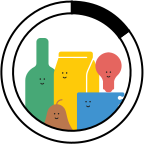
Reduce 13 % Reduce total waste generated by 13% compared to 2010
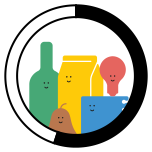
55 % of municipal waste prepared for reuse or recycling (at least 5% shall be textile waste, waste from electrical and electronic equipment, furniture and other waste that can be prepared for reuse).
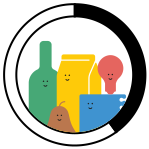
Amount of municipal waste sent to landfill: maximum 40% by weight of total municipal waste generated.
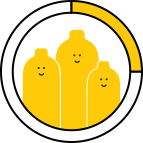
Only PET plastic bottles containing at least 25% recycled plastic will be placed on the market.
2026
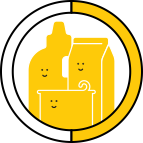
50 % reduction (by weight) of single-use plastics compared to 2022
2027

15 % maximum percentage of waste incorrectly sorted in the organic waste fraction.

85 % by weight (with respect to that placed on the market) of plastic bottles should be collected selectively for recycling.
2029

90 % by weight (with respect to that placed on the market) of plastic bottles should be collected selectively for recycling.
2030
Reduce total waste generated by 15% compared to 2010

60 % of waste must be prepared for reuse or recycling (at least 10% shall be textile waste, waste from electrical and electronic equipment, furniture and other waste that can be prepared for reuse).

70 % reduction (by weight) of single-use plastics compared to 2022
Only PET plastic bottles containing at least 30% recycled plastic will be placed on the market.

50 % reduction of food waste

Amount of municipal waste sent to landfill: maximum 20% by weight of total municipal waste generated.
2035
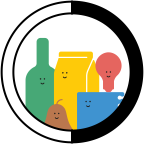
At least 50% by weight of the total municipal waste generated must be collected separately.

65 % of municipal waste prepared for reuse or recycling (at least 15% shall be textile waste, waste from electrical and electronic equipment, furniture and other waste that can be prepared for reuse).

Amount of municipal waste sent to landfill: maximum 10% by weight of total municipal waste generated.

We reduce the consumption of natural resources: by recycling materials, we give them a new lease of life, turning them back into raw materials.

By conserving natural resources, we help conserve the planet’s plant life, ecosystems and environment. A tree can capture up to 150 kg of CO2 a year (according to FAO).

We save water and energy and reduce greenhouse gas emissions and thus the consequences of climate change.

We contribute to preserving our health and that of the environment.

We help reduce the amount of waste deposited in landfills and thus extend their useful life.

Waste treatment is a source of employment, through reuse and recycling companies, waste handlers, treatment plants, etc.
