


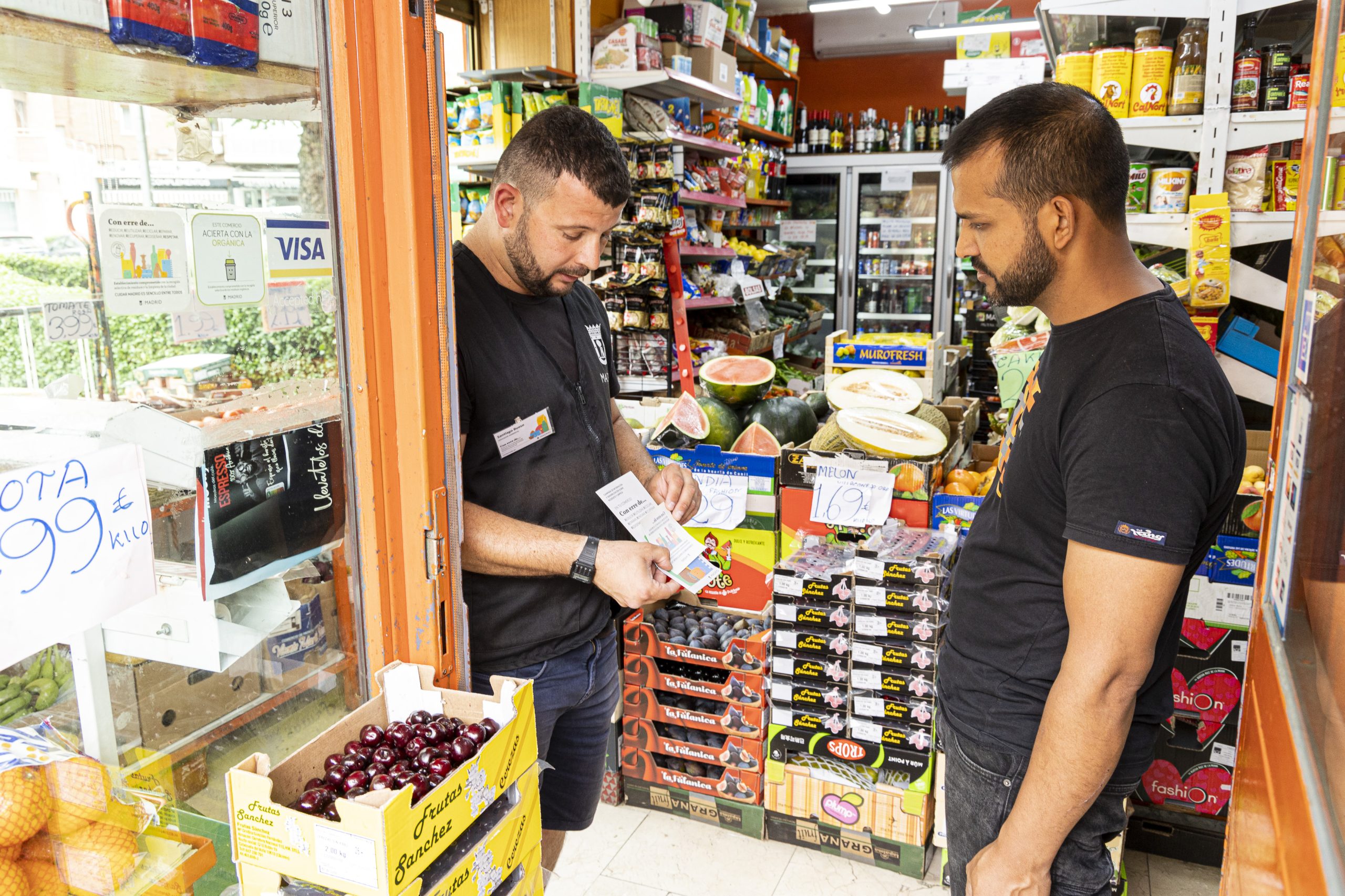
OUR VISITS TO BUSINESSES

One of the main activities the environmental educators of the “With ‘R’ for…” campaign perform are visits to establishments in areas with a high business density. These areas see intense business activity which therefore produces a large amount of waste of all kinds.
As is the case in households, it is vitally important that this waste be correctly separated at source to allow for the subsequent recycling of each of the types following collection. For this reason, the work carried out by our educational team is essential, as during these visits they provide information to every employee, manager or the owner of each establishment. In addition, they answer their questions, provide reference material in both physical and digital format, and simplify communications with the City Council to compile incidents, doubts or suggestions. A total of 20,503 visits to businesses have been made to date during the “With ‘R’ for…” campaign.
Although the activity itself is similar for all the establishments visited, the different types of business means that there can be no standard message. For example, a greengrocer’s shop will not produce the same type of waste or present the same needs as a restaurant or a shoe shop.
For this reason, our environmental educators know how to adapt the message to be conveyed in each case, depending on the business person and the nature of the establishment.
– HoReCa establishments (hotels, restaurants and catering): for these establishments it is important to differentiate all the types of waste to be separated, as they will produce food waste, packaging, glass, non-recyclable waste and even paper and cardboard. They are also reminded that if the business is on a commercial glass or cardboard collection route, they must make use of this service. Lastly, they are also informed of their responsibility for cleaning the outdoor terraces if they have one, and of the need to provide customers with ashtrays or bins.
– Greengrocers: at greengrocers it is essential to discuss the separation of organic waste and the need to have a brown-lidded bin to dispose of organic waste such as spoiled fruit and vegetables. They are also reminded to separate the packaging they produce, differentiating for example between small wooden boxes (to be placed in the yellow bin for packaging), cardboard boxes (to be disposed of in the blue bin for paper and cardboard) and cardboard boxes (to be placed in the blue bin for paper and cardboard).
– Shoe and stationery shops: in these establishments, the main type of waste they produce is cardboard. In this case, it is essential to remember the importance of properly folding the paper and cardboard containers, so as to reduce the overall volume and avoid the filling up the bins too quickly. When the establishment is in a commercial cardboard collection area, we emphasise that solely this service be used.
– Hairdressers: In hairdressing salons, our educators remind them that any electronic devices that need to be disposed of, such as hairdryers or hair straighteners, need to be taken to a clean point (Punto Limpio). It is also important to discuss the hair waste that is produced, as it is non-recyclable waste with biological content and must be placed in the orange-lidded bin for non-recyclable waste.
– Supermarkets: in supermarkets there can be different types of waste management. While some will have hired private management to handle all their waste, others use the council’s communal bins. In these cases, we explain the importance of correctly separating each of the types of waste the supermarket produces.
– Pharmacies: pharmacies are well aware of how waste medicines should be handled via the SIGRE collection point. However, it is important to remind the public that medicines should be taken to at the SIGRE point with their blister pack, the cardboard box and the information leaflet.
– Electronics shops: in this type of establishment, our educational team underlines the importance of dealing with electrical and electronic waste via the clean points or authorised waste managers, as this is a special type of waste. Many of these establishments have special bins to allow the public to recycle light bulbs, LEDs or other electrical or electronic waste.
These are some of the most common types of establishment visited by our educators from the “With ‘R’ for…” campaign. However, there are others, such as bakeries, beauty salons, pet shops, bazaars or food shops where the message to be conveyed is also adapted to each one in accordance with the type of waste produced and the needs of the business.
If you would like to get more details about these visits to businesses, you can follow us on the campaign’s social networks, on X @AciertaOrganica, and on Instagram @conrde_madrid, where we post, among others, multimedia content about the activities of our educational team. Proper waste management is necessary both in the home and in business.
Caring for Madrid is simple when we all participate.