


On January 24, the 5th Workshop on cleaning, collection and social facilities of Madrid City Council was held at La Nave, “For a cleaner Madrid”, under the title “Municipal services and the public”, to highlight residents’ co-responsibility in maintaining the city clean, together with the local administrations and the companies providing the services.
The day was a great success in terms of attendance and organization. It was attended by more than 300 people, who gathered at an event that included three exhibitions on services, several presentations and a round table to address the public’s needs in terms of accessibility, safety or environmental improvements, and which closed with a presentation of awards acknowledging the collaborating units and retired workers of the General Department of Cleaning and Waste Services.
The event was opened by the councillor for City Planning, Environment and Mobility, Borja Carabante Muntada, and the general director of Cleaning and Waste Services, Víctor Manuel Sarabia Herrero. The event was brough to a close by the councillor responsible for Cleaning Services and Green Areas, José Antonio Martínez Páramo.
Throughout the day, as usual, there was also time to see a video report on the facilities of the cleaning and waste collection services, which showed the great effort being made by the City Council in modernising these facilities, and the great job these workers were doing.
In addition, attendees were also able to enjoy three exhibitions: one already known “The history of a service in the shadows: evolution of cleaning and waste services”, another new exhibition as part of the information and awareness campaign on waste and cleaning “With ‘R’ for ….”and a third one on the new waste collection bins, for which the 5 types of street containers were installed: (organic, plastics, metals and tetrabriks, non-recyclable, paper and cardboard and glass), a textiles bin and a giant explanatory canvas on the criteria applied to its redesign and improved accessibility.
If you want to know in detail how was the programming of the event, or the different presentations that took place, you can access here to the program and other related content.
If you’d like to find out more about the campaign, you can follow us on the campaign’s social networks, on X @AciertaOrganica, and on Instagram @conrde_madrid, where we post multimedia content.
Caring for Madrid is simple if we all participate
As you know, last February 2022, under the slogan “With ‘R’ for…”, we launched the information and awareness campaign on waste separation and the cleanliness of public spaces in the city of Madrid, in order to continue to promote the reduction, separation and recycling of waste, as well as raising awareness among citizens about other problems related to the cleanliness and order of public spaces which directly affect the quality of life of the people of Madrid.
A team of 12 environmental educators has visited the 21 districts of the city during these two years, carrying out an admirable task informing and raising the public’s awareness.
During the first weeks of the campaign, the educational team conducted anonymous opinion surveys on the street, in which they learned which matters most concerned or worried citizens, such as: the state of cleanliness of the districts, the cleanliness problems that most impact citizens, waste separation habits, proper compliance with collection services, knowledge of the information channels of Madrid City Council, or suggestions for improving services.
After a preparatory phase, content creation and organization, the community actions started:
- Information booths
- Information booths at events
- Information for pet owners
- Information at critical points at the collection sites
- Information for businesses
- Educational activities
- Information sessions
- Street markets
Here is a brief summary of everything we have done so far:
| VISITS TO ESTABLISHMENTS | Visits | Open | Informed |
| Visits to businesses | 22,124 | 12,698 | 10,149 |
| Visits to outside bars/restaurants | 1,986 | 1975 | 1,582 |
| Visits to street markets | 1,473 | 1,273 | 1,148 |
| Total visits to businesses | 25,583 | 15,946 | 12,879 |
| SESSIONS AND WORKSHOPS | Sessions | Participants |
| Educational programme for schools | 1,883 | 38,640 |
| Information sessions for allies | 29 | 308 |
| Cooperation with libraries | 25 | 389 |
| Workshops and total participants | 1,937 | 39,337 |
| PEOPLE INFORMED ON THE STREET | Informed |
| Information booths | 15,318 |
| Information booths at events | 6,111 |
| Information at Critical Points | 2,241 |
| Information for pet owners | 3,347 |
| Total participants informed | 27,017 |
Throughout the month of January we will continue to accompany the public. This month you will find us at the information booths located at:
- CDM Luis Aragonés (from January 9 to 12) in the Hortaleza district.
- CDM Fuente Del Berro (January 16-19) in the Fuente del Berro district.
If you’d like to find out more about the campaign, you can follow us on the campaign’s social networks, on X @AciertaOrganica, and on Instagram @conrde_madrid, where we post multimedia content.
Caring for Madrid is simple if we all participate
The only limit to reusing materials is our imagination, and animal centres such as the Zoo Aquarium in Madrid or Faunia know this all too well, as they take advantage of many reused materials to create materials used in the facilities and for environmental enrichment activities.
Want to find out more?
One of the most important factors for an animal’s comfort are their rest and play areas. For many years, hoses donated by the Community of Madrid Fire Brigade have been used to build hammocks in the Panda bear, orangutan, gorilla and capuchin monkey areas at the Madrid Zoo and at the Saimiri facility at Faunia (among many others). They could no longer be used for putting out fires, but still had a lot of life left in them.
One strategy that is conducive to the physical and mental well-being of zoo animals is their environmental enrichment, which seeks the following objectives:
- To create dynamic, attractive environments that offer new stimuli to the animals’ everyday life.
- To provide cognitive challenges and opportunities to interact with other members of the group.
- To encourage naturally rewarding behaviours.
- To help them stay in good physical shape and exercise as they would in their natural setting.
To achieve all these goals, the children who take part in camps or activities at the Madrid Zoo Aquarium prepare different experiences for the animals at the zoo. These can range from preparing their food in special ways (different from usual), to hiding pieces of fruit in reused materials such as bottles, hoses… or creating special toys out of crates, egg cartons or old T-shirts no longer used. These environmental education activities help to improve the wellbeing of the zoo’s inhabitants and to raise awareness among children about the importance of reusing materials and caring for and respecting the environment. If you’d like to know more details, you can follow us on the campaign’s social networks, on @AciertaOrganica, and on Instagram @conrde_madrid, where we publish, among others, multimedia content on the campaign’s actions, waste issues and circular economy.
On Monday 13 November, Jose Antonio Martínez Páramo, Head of the Delegate Area of Cleaning Services and Green Spaces, awarded the prize to the winner of the 4th Instagram contest of the “With ‘R’ For…” campaign at Madrid City Council, none other than a folding electric bicycle.
Congratulations Blanca!
The competition was held from 23 to 29 October in the @conrde_madrid campaign profile, when an electric bicycle was raffled off to promote sustainable mobility in the city, in keeping with the strategic lines of Madrid City Council’s “Cambia 360 Plan”, which seeks to encourage micro-commuting around the city. Nearly 250 people took part in the event, proposing different reasons to support sustainable mobility, among them:
- Improved quality of life for the people of Madrid.
- Sustainability to preserve the health of our “home”, the planet.
- To live in a healthier environment.
- To drive around the city with a smile.
- Getting to work by exercising and taking care of the environment.
- Reducing day-to-day stress.
- Helping the traffic to flow more smoothly around the city.
- Having a more pedestrian-friendly city.
- Reducing CO2 emissions.
Thanks to its publication on social networks, we reach a large number of people, although many of them have become followers of the campaign profile during these almost two years, having met us during different activities aimed at informing and raising awareness about the need to correctly separate waste and keep the city clean.
Since February 2022 we have…
- Carried out educational activities in over 200 schools with around 30,000 children.
- Given information door-to-door to over 23,000 retailers in the catering, greengrocers, shoe shop, stationers, supermarkets, pharmacies, pet shop sectors….
- Set up 107 booths with an attendance of over 19,000 people who received a separator kit and information about the campaign.
- Visited more than 650 containerisation points and spoken to over 2000 members of the public.
- Interacted with nearly 3,000 pet owners in 400 parks and dog-friendly areas across the 21 districts in the city.
- Held information sessions for over 300 people who have attended and helped us spread the campaign message.
- And much more….
If you would like to know more details, you can follow us on the campaign’s social networks, on X @AciertaOrganica, and on Instagram @conrde_madrid, where we post, among others, multimedia content about this activity carried out by our educational team.
Taking care of Madrid is easy when all of us do it.
Did you know that 100 billion garments are made in the world every year and that, according to the latest Pulse of the Fashion Industry report by the Global Fashion Agenda, 92 million tons of textiles end up directly in landfills? Reducing consumption of textiles is essential, so it is vital to raise awareness and encourage people to repair and reuse them after buying them.”
This excessive level of manufacturing was not always the case and how we dispose of clothes no longer in use has changed. Let’s start by giving you a brief historical summary of how clothing has been used over time:
- In the 18th century, clothing was very expensive and was heavily reused; the remnants of garments were the basis for weaving and making new garments. Even in high society clothes were reused or given to the domestic staff or to ragmen. These bought and sold used clothing, as well as other tools and trinkets. Old dresses would also end up dressing images in churches.
- The Industrial Revolution saw the introduction of mechanization and lighter fabrics began to be made, making clothing items cheaper and so buying a lot of them became a habit. Clothing became democratised, more available to everyone.
With the invention of the cotton ginning machine together with the spinning machine, it was possible to optimise the use of cotton, which was first spun in Europe in the 18th century. The resulting fabric was muslin. The textile industry took longer to reach developing countries, but when it finally arrived, it created the current problem: clothes made in one place, designed in another, sold in another… travelling thousands of miles around the planet with the resulting increase in CO2 emissions.
The idea of acquiring new clothes and changing them several times a day and for every occasion first arose in high society around the 19th century. And with the industrial revolution, production costs fell even further.
- Now in the 20th century, in the 20-30s, second-hand stores began to appear in Spain, so as to avoid discarding clothes but instead reusing them. Later, in the 1960s, with the advent of synthetic dyes, production costs were further reduced and large-scale production began. During the 1970s and 1980s, clothing was given primarily to needy relatives, friends or neighbours. It was during the 1990s when community ties became stronger and most of the clothing was donated in parishes to the needy, and was then used by families, where it was mended and patched until no longer usable, and even then, was often reused as rags for cleaning the house.
- The 21st century saw the arrival of street bins for reusing and recycling clothes, lending anonymity to these garments we no longer wear. At present in Madrid, there are 958 municipal clothing and footwear bins, as well as those of Humana, RecuMadrid, Caritas…
So, if we want to reduce the impact caused by the overproduction of textiles, we need to adopt sustainable and responsible habits, buying less, but of better quality. And a society in which the mending, reuse and recycling of clothing and footwear is encouraged. What options are there for the people of Madrid?
- Second-hand clothing shops.
- Markets where used products and reused clothes are sold, such as the Madrid flea market, Mercado de motores, a model for sustainable, local consumption for the last 10 years.
- And, of course, digital platforms for reusing items.
In short: Reusing them lies in your hands!
Municipal markets are an important ally in spreading the message of our campaign, as thousands of people pass through them every week and the way they shop matters. In this last round they will be our main locations, along with some Municipal Sports Centres where we were not able to appear this summer.
If you visit our stands you will be able to receive several reference materials (information leaflets, infographics, waste separation guides for children or adults…) and other items that will make it easier for you to take up new, day-to-day habits, helping you to reduce waste and improve its separation at home (10-litre aerated bins for organic waste, vegetable oil separation funnel…).
Roaming dates in November, December and January:
| DATES | LOCATION | SCHEDULE |
| From October 24 to 27 | USERA MARKET | from 9:30 am to 1:30 pm |
| From November 14 to 17 | PACÍFICO MARKET | from 9:30 am to 1:30 pm |
| From November 21 to 24 | MUNICIPAL MARKET OF MEDIODÍA ENTREVÍAS | from 9:30 am to 1:30 pm |
| From November 28 to 1 December | MUNICIPAL MARKET OF LA PAZ | from 9:30 am to 1:30 pm |
| From December 12 to 15 | MUNICIPAL MARKET OF SANTA EUGENIA | from 9:30 am to 1:30 pm |
| From December 19 to 22 | CDM LUIS ARAGONÉS | from 12:30 to 7 pm |
| From January 9 to 12 | CDM HORTALEZA | from 12:30 to 7 pm |
| From January 16 to 19 | CDM FUENTE DEL BERRO | from 12:30 to 7 pm |
Locations
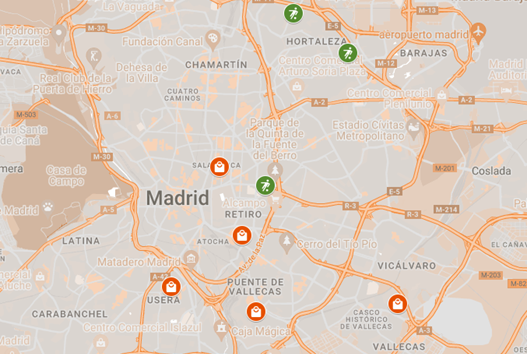
Come and see us! Our educational team will be happy to answer your questions about how to correctly reduce and separate any waste at home, provide you with tips and recommendations and also inform you about the waste management and street cleaning services available to the public.
If you would like to know more details, you can follow us on the campaign’s social networks, at X @AciertaOrganica, and on Instagram @conrde_madrid, where we post, among others, multimedia content about this activity carried out by our educational team.
Taking care of Madrid is easy when all of us do it.
One of the main activities the environmental educators of the “With ‘R’ for…” campaign perform are visits to establishments in areas with a high business density. These areas see intense business activity which therefore produces a large amount of waste of all kinds.
As is the case in households, it is vitally important that this waste be correctly separated at source to allow for the subsequent recycling of each of the types following collection. For this reason, the work carried out by our educational team is essential, as during these visits they provide information to every employee, manager or the owner of each establishment. In addition, they answer their questions, provide reference material in both physical and digital format, and simplify communications with the City Council to compile incidents, doubts or suggestions. A total of 20,503 visits to businesses have been made to date during the “With ‘R’ for…” campaign.
Although the activity itself is similar for all the establishments visited, the different types of business means that there can be no standard message. For example, a greengrocer’s shop will not produce the same type of waste or present the same needs as a restaurant or a shoe shop.
For this reason, our environmental educators know how to adapt the message to be conveyed in each case, depending on the business person and the nature of the establishment.
– HoReCa establishments (hotels, restaurants and catering): for these establishments it is important to differentiate all the types of waste to be separated, as they will produce food waste, packaging, glass, non-recyclable waste and even paper and cardboard. They are also reminded that if the business is on a commercial glass or cardboard collection route, they must make use of this service. Lastly, they are also informed of their responsibility for cleaning the outdoor terraces if they have one, and of the need to provide customers with ashtrays or bins.
– Greengrocers: at greengrocers it is essential to discuss the separation of organic waste and the need to have a brown-lidded bin to dispose of organic waste such as spoiled fruit and vegetables. They are also reminded to separate the packaging they produce, differentiating for example between small wooden boxes (to be placed in the yellow bin for packaging), cardboard boxes (to be disposed of in the blue bin for paper and cardboard) and cardboard boxes (to be placed in the blue bin for paper and cardboard).
– Shoe and stationery shops: in these establishments, the main type of waste they produce is cardboard. In this case, it is essential to remember the importance of properly folding the paper and cardboard containers, so as to reduce the overall volume and avoid the filling up the bins too quickly. When the establishment is in a commercial cardboard collection area, we emphasise that solely this service be used.
– Hairdressers: In hairdressing salons, our educators remind them that any electronic devices that need to be disposed of, such as hairdryers or hair straighteners, need to be taken to a clean point (Punto Limpio). It is also important to discuss the hair waste that is produced, as it is non-recyclable waste with biological content and must be placed in the orange-lidded bin for non-recyclable waste.
– Supermarkets: in supermarkets there can be different types of waste management. While some will have hired private management to handle all their waste, others use the council’s communal bins. In these cases, we explain the importance of correctly separating each of the types of waste the supermarket produces.
– Pharmacies: pharmacies are well aware of how waste medicines should be handled via the SIGRE collection point. However, it is important to remind the public that medicines should be taken to at the SIGRE point with their blister pack, the cardboard box and the information leaflet.
– Electronics shops: in this type of establishment, our educational team underlines the importance of dealing with electrical and electronic waste via the clean points or authorised waste managers, as this is a special type of waste. Many of these establishments have special bins to allow the public to recycle light bulbs, LEDs or other electrical or electronic waste.
These are some of the most common types of establishment visited by our educators from the “With ‘R’ for…” campaign. However, there are others, such as bakeries, beauty salons, pet shops, bazaars or food shops where the message to be conveyed is also adapted to each one in accordance with the type of waste produced and the needs of the business.
If you would like to get more details about these visits to businesses, you can follow us on the campaign’s social networks, on X @AciertaOrganica, and on Instagram @conrde_madrid, where we post, among others, multimedia content about the activities of our educational team. Proper waste management is necessary both in the home and in business.
Caring for Madrid is simple when we all participate.
Libraries play an essential role in encouraging people to read, while providing information, entertainment and services to help the public (especially children and young people) in their intellectual growth.
For this reason, a few months ago we began to collaborate with the Municipal Public Libraries of Madrid, in order to inform a wider range of the population about the importance of waste separation and the cleanliness of the city.
Here is a list of activities we are currently carrying out in libraries:
- Information booths, where the public can get information and answer all their questions about the new campaign.
- Information sessions: aimed at people of all ages. You can check at your nearest library if we will be there soon.
- Activities of our educational program aimed at children.
Over the coming months, you will be able to find our information booth at the following libraries:
| DATES | VENUE | SCHEDULE |
| From 4 to 7 July | BPM MANUEL VÁZQUEZ MONTALBÁN | 9 am to 3 pm |
| From 11 to 14 July | BPM LA CHATA | 9 am to 3 pm |
| From 18 to 21 July | BPM MARÍA LEJÁRRAGA | 9 am to 3 pm |
| From 5 to 8 September | BPM VICÁLVARO | 9 am to 3 pm |
| From 12 to 15 September | BPM SAN FERMÍN | 12:30 to 7 pm |
| From 19 to 22 September | BPM LA CHATA | 12:30 to 7 pm |
| From 26 to 29 September | BPM PÍO BAROJA | 12:30 to 7 pm |
| From 3 to 6 October | BPM HUERTA DE LA SALUD | 12:30 to 7 pm |
| From 17 to 20 October | BPM MARIO VARGAS LLOSA | 12:30 to 7 pm |
| From 24 to 27 October | BPM MARÍA ZAMBRANO | 12:30 to 7 pm |
| 7 to 10 November | BPM JOSÉ SARAMAGO | 12:30 to 7 pm |
Map of our tour around the Municipal Public Libraries (MPB)
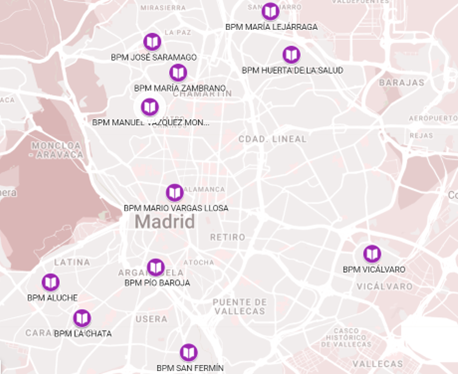
Come and visit us. Our educational campaign team will be happy to inform you, provide you with reference materials to help you with separating waste at home and answer any questions you may have. There are still more to join, check our map to stay informed about the locations and dates of the new activities that will take place in conjunction with the libraries.
We look forward to seeing you there!
And remember! You can also follow our campaign on our Instagram account. @conrde_madrid; where we post every day, or you can send us an email to comunica.limpiezaresiduos@madrid.es if you need more information or have any questions.
Taking care of Madrid is easy when all of us do it.
European Mobility Week (EMW) takes place every year from 16 to 22 September. During this week activities are carried out to raise awareness among the public for them to adopt habits such as using public transport, cycling or walking so as to promote sustainable mobility.
More and more European cities are taking up a celebration that began in 2000 and is promoted each year by the European Commission. During this week, European cities carry out all kinds of activities focused on sustainable mobility. This week also ends with the celebration of World Car-Free Day on 22 September.
This year’s topic was energy efficiency, with the slogan “Combine and move”. And naturally, the “With R for…” campaign took part with the campaign’s information booth at two events held on 15 and 17 September.
Parking Day (Friday, 15 September)
Parking Day is one of the activities that form part of European Mobility Week. On this day, some of the parking spaces reserved for cars or other vehicles in front of schools are transformed into public spaces for the public’s participation. The aim of this is to raise awareness of the need to reclaim public space for the citizens, to the detriment of those parking spaces reserved for private transport.
In one of these parking spaces, next to the Francos Rodríguez metro station, the “With R for…” campaign had its information booth, in conjunction with the CIEA Dehesa de la Villa. Despite the poor weather conditions, almost a hundred people visited our booth to receive information from the campaign team of environmental educators. Not only did they talk about waste management and street cleaning, but also about Parking Day and the European Mobility Week.
Paseo de Coches del Retiro (Sunday, 17 September)
The chief event of European Mobility Week in Madrid was held on Sunday 17 September at Retiro Park. All along the Paseo de Coches numerous tents of different organisations were set up to highlight the importance of sustainable mobility.
On this occasion, the “With R for…” campaign participated with an information booth in conjunction with the REMAD service of Madrid City Council, dedicated to the reuse and exchange of objects among the public at the city’s fixed Clean Points.
Approximately a hundred people visited our campaign booth during the day to put their questions to our team of environmental educators. As with the Parking Day, as well as discussing waste management and street cleaning, we were also able to raise awareness about sustainable mobility and its relationship with waste management in the city of Madrid.
In this way, our educational team was able to explain that, by recycling the organic waste we separate, we can obtain biomethane which can be used to run around 600 EMT buses a year, using compressed natural gas (CNG). In addition, they also recalled that the recovery of part of the waste from the non-recyclable remainder can be used to obtain electrical energy to supply the Bicimad bicycle network.
After holding these events, as well as other activities that have taken place during these days, European Mobility Week 2023 comes to an end with a great reception by the public despite the rain. See you at EMW 2024!
For Sustainable Mobility!
You’ve probably seen them around your neighbourhood by now. Certain bins for the five types of waste collected in the city have changed in appearance over recent months. In June and July, Madrid City Council launched an initial pilot phase to renew certain bins and replace the existing ones. Over the coming months, it expects to meet its target of gradually replacing 30,000 bins throughout the city.
This renewal of the collection bins is not the only change, as there is an information campaign distributing flyers, posters put up in neighbouring communities plus environmental educators on the streets. These educators will play a key role in informing the public about all the new features of these new bins:
- They have been manufactured using 100% renewable energy.
- They are designed to allow parts to be replaced when damaged without affecting them overall, so they can be removed and recycled to make new ones.
- They are more accessible and ergonomic.
- The five types of bin have a standard height of 150 centimetres, making them easier to empty and maintain.
- They have a greater capacity than some of the current ones.
- They are equipped with capacity sensors set for them to be emptied when they reach 80% of their capacity.
- They have deodorisers.
- In addition, they have devices to detect any anomalies such as fires or if a bin is moved.
All these advantages and functionalities improve the waste collection service, which will result in a more efficient and sustainable service in keeping with the principles of circular economy.
However, in order to achieve efficiency and sustainability, we must not forget that waste collection starts at home, by correctly separating out our waste and disposing of it in the right bins, thus ensuring the efficiency of the subsequent process.
For a more sustainable Madrid for everyone!